


GLOBAL BRANDS LOOKING FOR UNIFIED FULFILMENT



For many beauty and cosmetics brands, growth follows a familiar path.
A strong direct-to-consumer (DTC) or ecommerce presence builds brand recognition and a loyal customer base early on. But, over time, ambitions often extend beyond online channels into wholesale, department stores, specialist retailers, and international distribution partners. This shift into business-to-business (B2B) retail fulfilment can unlock significant scale and revenue, but it also introduces a very different set of operational demands.
A common misconception is that retail fulfilment is simply ecommerce at a larger volume. However, it requires different infrastructure and a deeper understanding of how supply chains, compliance, and service-level expectations operate in a retail environment.
For beauty and cosmetics brands, added layers of complexity around regulation, shelf life, presentation, and brand integrity make getting this right even more critical.
This article explores what beauty and cosmetics brands need to consider when preparing for B2B retail fulfilment.
In this article
Understanding the difference between ecommerce and retail distribution
Two channels, two operating models
Ecommerce and retail may both result in products reaching the end consumer, but the routes they take and the expectations placed on brands along the way are fundamentally different.
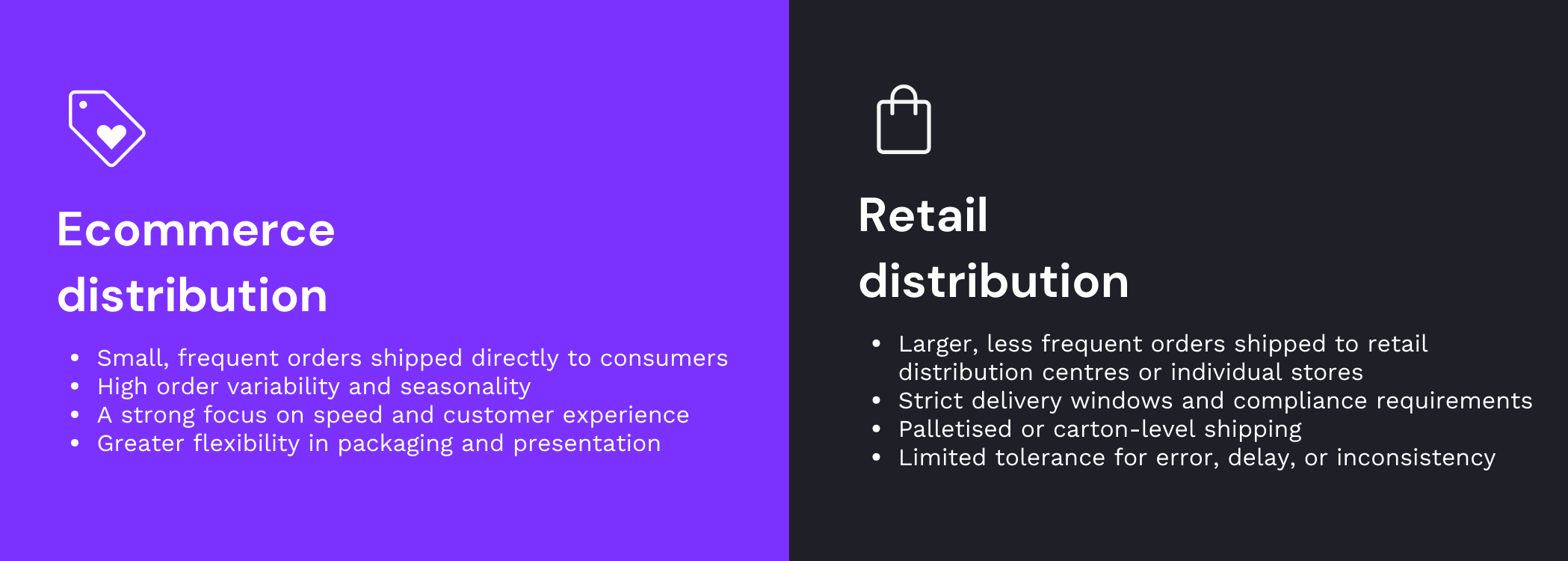
Ecommerce distribution is typically characterised by:
- Small, frequent orders shipped directly to consumers
- High order variability and seasonality
- A strong focus on speed and customer experience
- Greater flexibility in packaging and presentation
Retail distribution, on the other hand, usually involves:
- Larger, less frequent orders shipped to retail distribution centres or individual stores
- Strict delivery windows and compliance requirements
- Palletised or carton-level shipping
- Limited tolerance for error, delay, or inconsistency
For beauty and cosmetics brands, these differences are amplified by product-specific considerations such as batch tracking, expiry dates, ingredient compliance, and presentation standards. Brands that thrive in ecommerce may find that their existing fulfilment setup struggles to meet retail demands without significant adaptation.
The strategic importance of channel balance
Before investing in B2B retail fulfilment, brands need a clear distribution strategy. This means understanding not only where they want to sell, but how each channel supports the wider business.
Key questions include:
- What proportion of revenue is expected to come from ecommerce versus retail?
- Which markets or regions are prioritised for retail expansion?
- How will retail pricing, margins and minimum order quantities impact profitability?
- What operational trade-offs are acceptable to support retail growth?
Some brands adopt a hybrid model, maintaining a strong DTC presence alongside selective retail partnerships.
Others lean heavily into retail, using ecommerce primarily for brand-building and product launches. Each approach places different demands on fulfilment infrastructure, and misalignment at this stage can create friction later.
Why retail-heavy brands need retail-ready fulfilment
Retailers operate on tight schedules and highly structured supply chains. Delivery slots, advance shipping notices (ASNs), labelling standards, pallet configurations, and packaging specifications are often mandated and strictly enforced. Failure to comply can result in refused deliveries and chargebacks.
For beauty and cosmetics brands, this environment leaves little room for improvisation. Retailers expect accuracy and reliability at scale. Fulfilment processes that work well for picking individual ecommerce orders may not translate to efficiently handling full pallet or mixed-case wholesale shipments.
Scaling volume without losing control
Retail expansion often brings rapid increases in order volume due to major product launches and peak season activity or expansion into new international markets. Without the right fulfilment setup, brands can find themselves overwhelmed, leading to:
- Inventory inaccuracies
- Delayed shipments
- Increased error rates
- Strained retailer relationships
Retail-ready fulfilment focuses on scalability without sacrificing control. This includes robust fulfilment operating systems, clear processes for inbound and outbound flows, and the ability to flex capacity in response to demand.
Protecting brand integrity at scale
In beauty and cosmetics, the product experience extends beyond the formula itself. Packaging, presentation, condition on arrival, and unboxing experiences all contribute to how the brand is perceived by retailers and consumers alike.
Retail fulfilment introduces more touchpoints – pallets, cartons, transit hubs, store backrooms – each of which presents a risk to product integrity if not managed carefully. Fulfilment partners must understand how to handle cosmetic products correctly, from temperature considerations to protective packaging and careful palletisation.
Key operational considerations for beauty and cosmetics brands
Regulatory and compliance requirements
Beauty and cosmetics products are subject to stringent regulations, which vary by market. When supplying retailers, brands are often required to demonstrate compliance not just at the product level, but throughout the supply chain.
This may include:
- Batch and lot tracking
- Expiry date management (FIFO/FEFO)
- Ingredient and labelling compliance
- Documentation for audits and retailer reviews
A fulfilment operation that lacks visibility or traceability can quickly become a liability, particularly when dealing with recalls or regulatory inspections.
Inventory management across channels
Managing inventory for both ecommerce and retail from a single pool can be efficient, but it also introduces complexity. Retail orders may require large allocations of stock with long lead times, while ecommerce demand remains unpredictable.
Brands need systems and processes that allow them to:
- Forecast demand accurately across channels
- Reserve stock for key retail accounts
- Avoid overselling or stockouts
- Maintain optimal stock levels to manage cash flow
Fulfilment plays a central role in enabling this balance, providing real-time visibility and control over inventory movements.
Packaging and presentation standards
Retailers often specify how products are prepared for shipment, from packing and labelling through to pallet configuration. This can differ significantly from ecommerce packaging, which prioritises protection and branding.
Beauty and cosmetics brands may need to manage:
- Multiple packaging configurations
- Retail-ready cartons and shelf-ready packaging
- Retail-specific labelling and barcoding
A fulfilment partner with experience in retail preparation can help brands navigate these requirements without adding unnecessary complexity in-house.
Common pain points when entering B2B retail fulfilment
Underestimating operational complexity
One of the most common challenges brands face is underestimating how different retail fulfilment is from ecommerce. What begins as a few wholesale orders can quickly evolve into a demanding operation requiring dedicated resources and expertise.
Without the right support, brands may find themselves firefighting issues rather than focusing on growth.
Fragmented fulfilment setups
Some brands attempt to manage ecommerce and retail fulfilment through separate providers or internal teams. While this can work in the short term, it often leads to inefficiencies due to duplicated processes and limited visibility across the supply chain.
An integrated approach, where both channels are supported within a cohesive fulfilment model, can reduce complexity and improve responsiveness.
Limited scalability
Retail success can be unpredictable. A strong launch with a major retailer or a sudden international opportunity can strain fulfilment operations that were designed for smaller volumes.
Brands that lack scalable fulfilment risk damaging retailer relationships at precisely the moment when momentum is building.
How the right fulfilment partner can support retail growth
Experience with beauty and cosmetics
Fulfilment is not one-size-fits-all. Beauty and cosmetics products require specific handling, storage, and compliance considerations. A partner with sector experience understands these nuances and can anticipate challenges before they become problems.
Infrastructure built for both ecommerce and retail
For brands operating across multiple channels, fulfilment infrastructure needs to support both models seamlessly. This includes:
- Fulfilment centres designed for mixed picking and pallet operations
- Systems that handle diverse order profiles
- Processes that maintain accuracy and efficiency at scale
Flexibility to evolve with the brand
Retail strategies evolve over time. New markets, new retailers, and new product lines all place changing demands on fulfilment. A strong fulfilment partner offers flexibility, adapting processes and capacity as the brand grows.
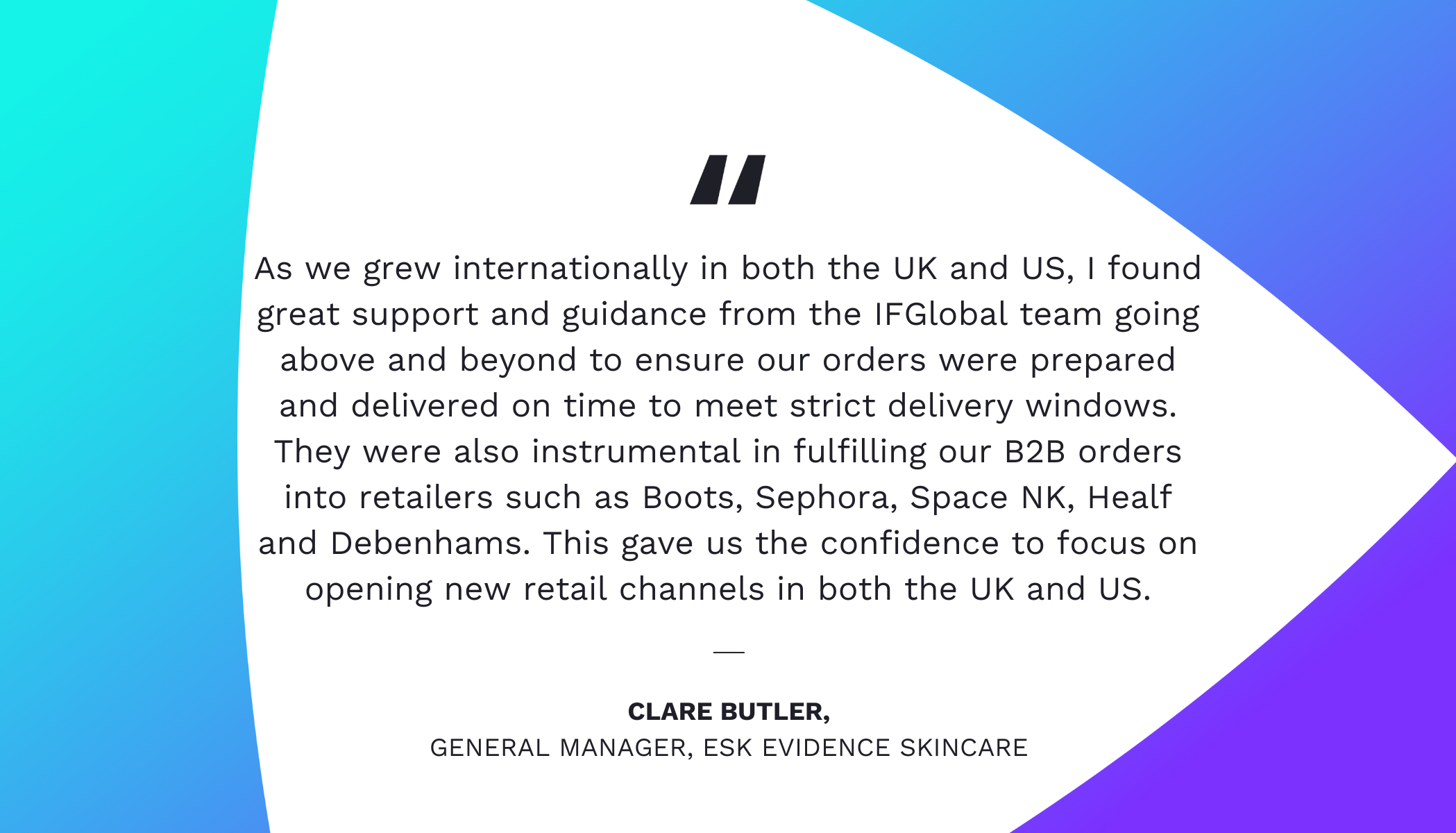
"As we grew internationally in both the UK and US, I found great support and guidance from the IFGlobal team going above and beyond to ensure our orders were prepared and delivered on time to meet strict delivery windows. They were also instrumental in fulfilling our B2B orders into retailers such as Boots, Sephora, Space NK, Healf and Debenhams. This gave us the confidence to focus on opening new retail channels in both the UK and US." - Clare Butler, General Manager, ESK Evidence Skincare.
IFGlobal’s role in supporting beauty and cosmetics brands
At IFGlobal, we partner with beauty and cosmetics brands at various stages of their retail journey, from early wholesale expansion to established international distribution.
Our approach is grounded in understanding the operational realities of retail fulfilment and supporting brands in building resilient, scalable supply chains.
Rather than focusing solely on execution, we support brands by:
- Helping you align fulfilment strategy with distribution goals
- Providing infrastructure that supports both ecommerce and retail
- Offering visibility and control across the supply chain
- Supporting with meeting compliance standards
By removing operational friction, we enable brands to focus their time and energy on product innovation, marketing, and building strong retail partnerships.
Preparing for long-term retail success
Entering B2B retail fulfilment is a significant milestone for beauty and cosmetics brands. It signals maturity and the potential for meaningful scale. However, success in retail is rarely achieved through product alone. Operational excellence and consistency are equally important.
By understanding the differences between ecommerce and retail distribution, investing in retail-ready fulfilment, and addressing common pain points early, brands can set themselves up for sustainable growth. Fulfilment should not be an afterthought, but a strategic enabler – one that supports the brand’s vision rather than constraining it.
For beauty and cosmetics brands navigating this transition, informed decisions and the right partnerships can make the difference between short-term wins and long-term success.