


GLOBAL BRANDS LOOKING FOR UNIFIED FULFILMENT



We speak daily with brands navigating the reality of selling across borders, channels, and customer types. Some were born online and now lead in DTC. Others come from traditional wholesale but are reinventing themselves in ecommerce. Many sit somewhere in between. A subscription model here, a marketplace presence there, a retail partnership launching next quarter. However, they all share one common challenge in that growth introduces operational complexity faster than it introduces revenue.
We know from experience that what holds businesses back isn’t lack of demand or product innovation. It’s the operational friction that creeps in behind the scenes.
- Demand is strong, but inventory lives in spreadsheets.
- B2B orders require manual workarounds.
- DTC orders spike after a promotion, but warehouse workflows don’t keep up.
- Teams manage five dashboards but trust none of them.
In nearly every case, the hidden friction sits in one place. Order management.
As a global fulfilment partner, we’ve watched this shift unfold across hundreds of brands and millions of orders. The lesson is consistent; the retail brands that scale cleanly are the ones that invest early in smart, unified order management.
In this article, we’ll explore why smart order management is now one of the most strategic capabilities for brands entering 2026 and how it powers both DTC and B2B expansion.
In this article
- Why order management is no longer just operational
- What smart order management really means
- Why this matters for DTC and B2B expansion in 2026
- Connected vs fragmented operations
- 5 ways smart order management can accelerate growth
- The future: AI-powered, predictive order management
- How to build a smart order management foundation
-
BladePRO: The fulfilment operating system powering fast-growing brands
Why order management is no longer just operational
For years, order management was considered a back-office function; the plumbing of commerce. But the reality is that your customer experience is now directly tied to your operational intelligence.
What happens after a shopper clicks “buy”, or after a retailer places a replenishment order, has become just as important as the marketing that brought them there. If fulfilment stumbles – slow routing, stock inaccuracies, late dispatch, poor tracking communication – customers don’t blame the warehouse, they blame the brand.
Research from PwC shows that 73% of customers consider experience a key factor in purchasing decisions, with B2B buyers expecting the same visibility and speed as DTC consumers.
The bar has risen. Smart order management is how brands consistently meet that bar across every channel, geography, and customer type.
What smart order management really means
Smart order management isn’t a single piece of software, it’s an ecosystem of connected processes and technologies that give you visibility, automation and control across every stage of fulfilment.
At its best, smart order management:
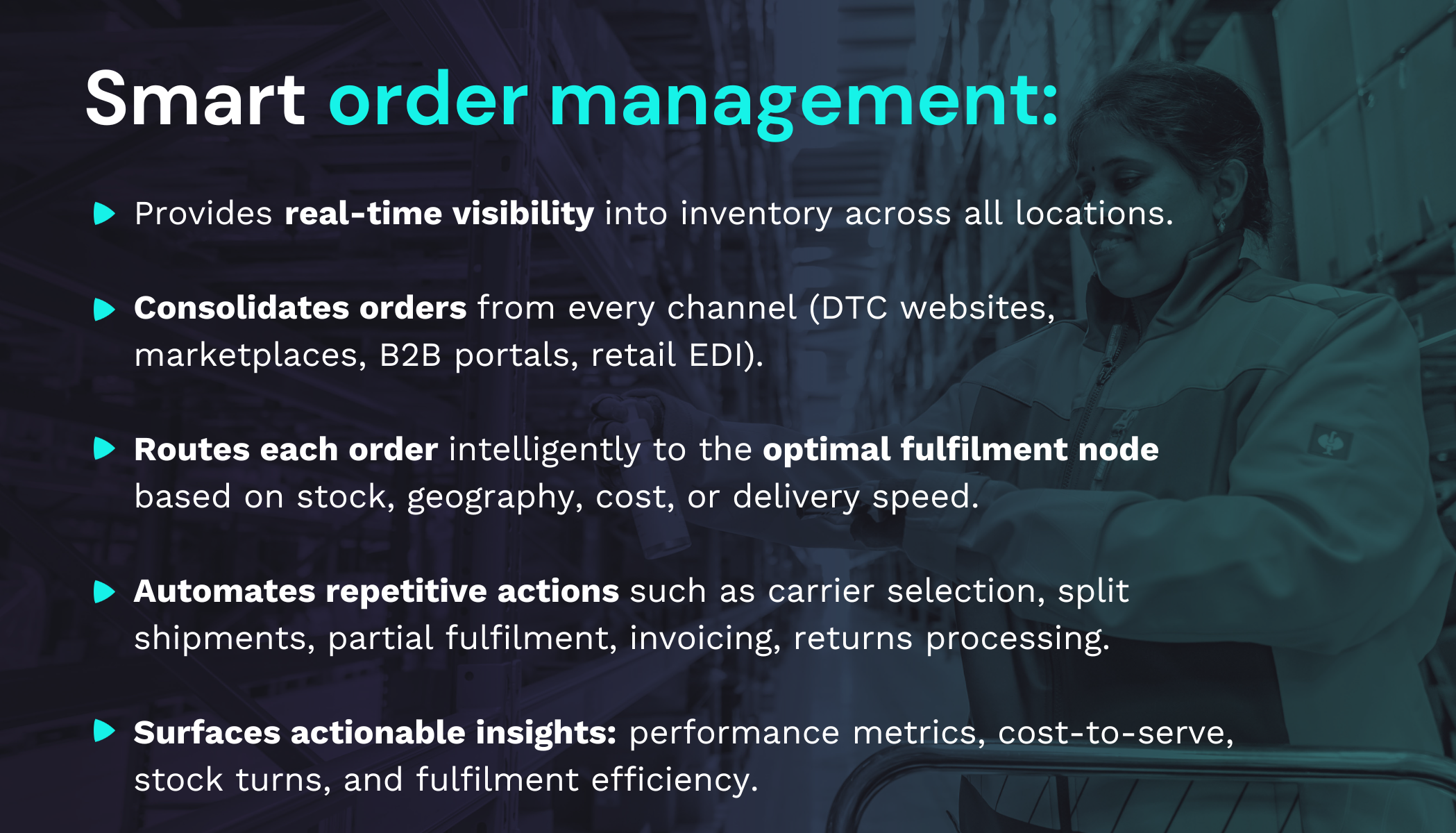
- Consolidates orders from every channel (DTC websites, marketplaces, B2B portals, retail EDI).
- Provides real-time visibility into inventory across all locations.
- Routes each order intelligently to the optimal fulfilment node based on stock, geography, cost, or delivery speed.
- Automates repetitive actions such as carrier selection, split shipments, partial fulfilment, invoicing, returns processing.
- Surfaces actionable insights: performance metrics, cost-to-serve, stock turns, and fulfilment efficiency.
A powerful fulfilment operating system, like our very own BladePRO, transforms your operation from a chain of disconnected systems into a single, intelligent network.
BladePRO unifies order flows, inventory logic, automation rules, and warehouse operations across all our facilities. It’s this intelligence layer that allows brands to operate globally without the operational drag that typically follows expansion.
Built from over 20 years of hands-on experience, it unites data, automation and real-time insight to deliver the efficiency, visibility and scalability that growing ecommerce brands need to thrive.
See how BladePRO can simplify your fulfilment, streamline your operations and scale your brand.
Why this matters for DTC and B2B expansion in 2026
The ecommerce landscape in 2026 looks very different to five years ago. The lines between DTC and B2B are blurring.
A brand might run a Shopify store, supply Amazon, service wholesale accounts, and sell via TikTok Shop, all simultaneously. This diversity is healthy for growth, but only if your operational backbone can support it.
Real examples we see include:
- A beauty brand moving from pure DTC to supplying salons and retailers.
- A pet food brand expanding from B2B wholesale into subscription-based consumer packs.
- A fashion label adding a “buy now, pick up in store” layer to its ecommerce strategy.
Each move multiplies order types, fulfilment rules, inventory flows, data sources, and SLA expectations. Without intelligent automation and visibility, the cracks show fast. Smart order management is what prevents those cracks from becoming chaos.
Connected vs fragmented operations
We often see two trajectories emerging among scaling brands.
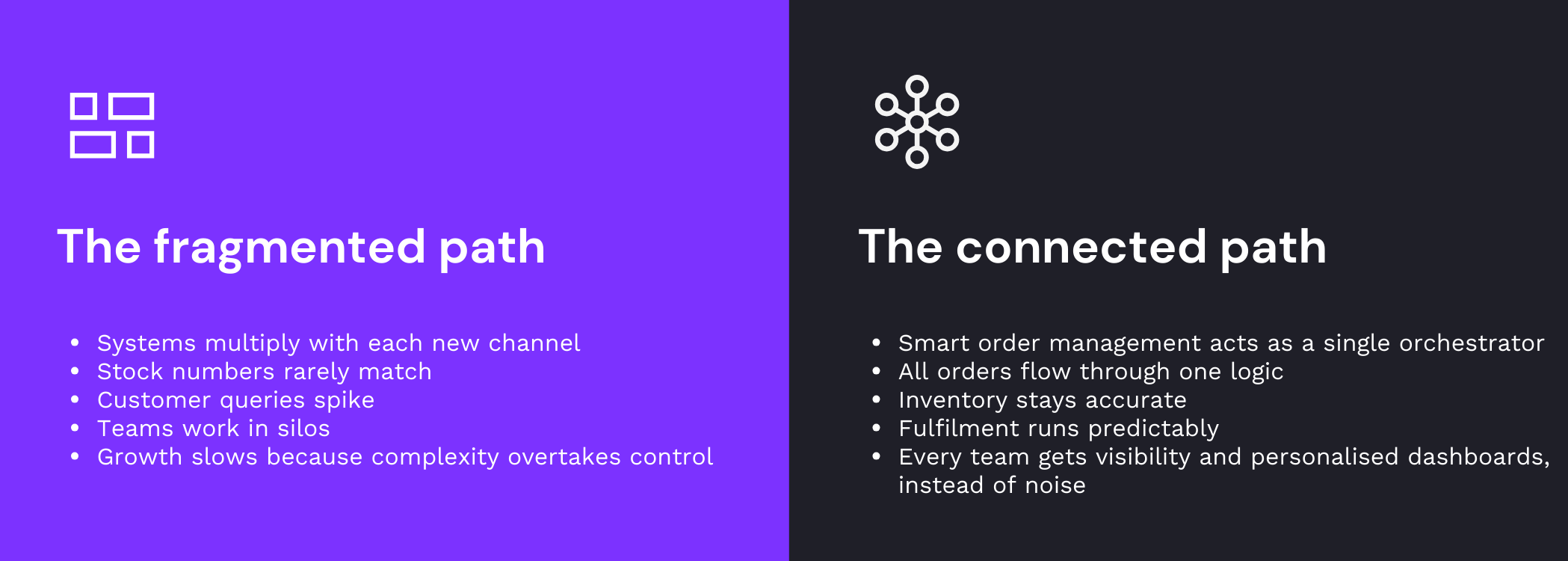
The fragmented path
- Systems multiply with each new channel
- Stock numbers rarely match
- Customer queries spike
- Teams work in silos
- Growth slows because complexity overtakes control
The connected path
- Smart order management acts as a single orchestrator
- All orders flow through one logic
- Inventory stays accurate
- Fulfilment runs predictably
- Every team gets visibility and personalised dashboards, instead of noise
In 2026, the difference between these two paths is existential. McKinsey reports brands using multichannel personalisation strategies can increase revenue by 5%–15% and improve marketing ROI by 10%–30%, but only if their operations are unified. Otherwise, those extra channels simply add operational debt.
5 ways smart order management can accelerate growth
1. It unifies DTC and B2B operations
Historically, brands managed consumer and wholesale orders separately. Today, that’s inefficient. Smart order management lets both coexist; same inventory, same data, different rules.
- DTC orders can flow straight to pick, pack and dispatch.
- B2B orders can trigger approval workflows, bulk pick rules, and invoice automation.
- All orders draw from the same real-time inventory.
Order management systems give shared visibility of a unified stock pool for simpler inventory management and less duplication of stock (and effort).
2. It turns inventory into a strategic assetIn an omnichannel world, inventory visibility can be a growth lever. The ability to see and redeploy stock dynamically across channels prevents stockouts or tying up capital in stock that won’t sell. Smart order management systems make this possible, showing not just what you have, but where it sits, how it moves, and where it’s most valuable.
3. It enables agile fulfilment and faster deliveryCustomers expect flexibility. A B2B retailer might want split shipments. A DTC shopper might want next-day delivery.
Smart order management orchestrates this automatically, routing orders to the most logical locational based on speed, cost and capacity. This agility helps brands offer faster, more consistent delivery times without inflating shipping costs.
4. It reduces operational cost and errorManual order handling may work at 100 orders a day, but at scale, it collapses. Automation through a smart Fulfilment Operating System reduces human touchpoints, cutting fulfilment errors (mispicks, mis-ships, duplicate orders) and improving cost-to-serve.
Yes, it’s about speed. But it’s also about freeing teams from firefighting so they can focus on growth strategy, not data reconciliation.
5. It delivers better customer and partner experiencesWhether your customer is a consumer or a retailer, they want transparency and consistency. Smart order management underpins both.
- Live order tracking for customers and account managers.
- Automatic communication when stock levels change or delivery times update.
- Accurate invoicing and reconciliation for B2B clients.
The result is trust, and trust scales faster than discounts ever could.
The future: AI-powered, predictive order management
As we move into 2026 and beyond, smart order management systems are getting even more advanced. With the more widespread use of ML (Machine Learning) and AI, systems are starting to:
- Predict/forecast fulfilment demand based on past sales trends and seasonality.
- Pre-allocate stock dynamically before orders even arrive.
- Optimise carrier selection using live performance data.
These predictive capabilities turn order management from a reactive process into a proactive advantage, helping brands position inventory closer to demand and anticipate bottlenecks before they hit.
How to build a smart order management foundation
If you’re planning DTC or B2B expansion, start with structure.
Here’s a practical roadmap we share with our clients to help them work smarter, not harder.
- Map every order flow, from checkout to fulfilment to return. Identify inefficiencies and manual decision points.
- Define cross-channel rules and standardise logic where possible, such as carrier selection or packaging rules.
- Integrate inventory systems so your fulfilment software can share a live data feed.
- Set KPIs for visibility: cost per order, fulfilment time, order accuracy, return rate.
- Pilot before scaling. Run one product line or channel through your new workflows, test data accuracy, and adjust.
- Expand gradually. Roll out to more channels or territories once stability and clarity are proven.
This approach makes sure control scales with you, rather than lagging behind growth.
BladePRO: The fulfilment operating system powering fast-growing brands
DTC and B2B channels increasingly overlap, and that’s where BladePRO gives brands the operational intelligence they need to scale confidently.
As our proprietary Fulfilment Operating System, BladePRO brings order and inventory management, returns management, and warehouse action into one unified platform. Key advantages for fast-growing ecommerce brands include:
- Unified order management across all channels; DTC, marketplaces, B2B, subscriptions, and retail partners - reducing fragmentation as you expand.
- Real-time global inventory visibility, allowing brands to manage a single stock pool across multiple markets and fulfilment nodes.
- Intelligent automation that handles routing, carrier selection, SLAs, batching, kitting, and returns with minimal manual intervention.
- Support for complex workflows, including batch and expiry tracking, custom bundles, and full B2B compliance (EDI, palletisation, documentation).
- Deep integrations with ecommerce platforms, marketplaces, and ERPs, eliminating data silos and providing consistent logic across systems.
- Reduced cost-to-serve through fewer errors, cleaner data, and automated decision-making. Essential as order volumes increase across channels!
- Scalable infrastructure designed to support multi-market expansion without adding operational friction or overhead.
Expanding into new markets or customer types is exciting, but complexity grows with every new channel. Smart order management is the invisible infrastructure that keeps that complexity in check.
And in 2026, when speed, accuracy, and experience are non-negotiable, it’s what turns growth ambition into operational reality. When your systems think smarter, your brand moves faster, and your team finally gets to do what they do best - build the next chapter of your business.