


GLOBAL BRANDS LOOKING FOR UNIFIED FULFILMENT



If you've ever experienced stock arriving late, labour sitting idle, customer orders being delayed or unexpected transport costs, it's tempting to look at your 3PL or fulfilment partner for answers.
Many fulfilment issues begin days, or even weeks, before inventory reaches your fulfilment centre.
A supplier misses a production deadline. Shipping documents are submitted late. A container is rolled to a later vessel. Customs requires additional information. Somewhere along the journey, communication breaks down. By the time your warehouse team learns about the problem, there's very little they can do except react.
This is why supply chain visibility has become one of the biggest priorities for modern logistics operations.
According to McKinsey's Global Supply Chain Leader Survey, 90% of organisations experienced significant supply chain disruptions, reinforcing that disruption is no longer an occasional event but an operational reality. The businesses that perform best aren't necessarily those that avoid disruption, but the ones that identify issues early enough to respond before customers are affected.
The challenge is that many organisations still treat freight forwarding, warehousing and fulfilment as separate services managed by different providers. Each handover creates another opportunity for delays, duplicated communication and lost visibility.
An integrated approach changes that.
Instead of seeing logistics as a series of disconnected activities, businesses gain a complete picture of their inbound supply chain; from supplier production through to warehouse receipt, making it easier to plan resources, reduce costs and deliver a more reliable customer experience.
In this article, we'll explore where visibility is typically lost, why inbound logistics deserves more attention, and how connecting every stage of the supply chain can reduce operational risk.
What’s in this article
Why warehouse visibility starts before dispatch
Warehouse visibility is often misunderstood.
Ask most operations teams about visibility and they'll immediately think about inventory accuracy, picking performance or order processing inside the warehouse.
Those metrics are undoubtedly important, but they only tell part of the story. By the time a pallet is scanned into your warehouse management system, dozens of critical events have already taken place.
Raw materials have been sourced. Manufacturing has been completed. Export documentation has been prepared. Collection has been arranged. Freight has been booked. Customs declarations have been submitted. Containers have moved through ports and transport networks before finally arriving at your fulfilment centre.
Each of those stages creates opportunities for delay.
The problem isn't simply that delays happen; global supply chains are inherently complex. The problem is that many businesses don't know about those delays until it's too late to adapt.
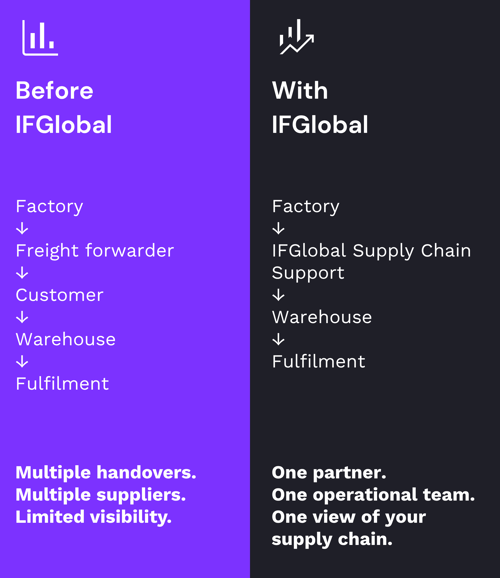
Imagine a supplier in Asia informs your freight forwarder that production will be three days late. If that information isn't quickly shared with your fulfilment centre, labour may still be scheduled, outbound orders may still be promised to customers and transport bookings may remain unchanged.
Suddenly, one small delay begins creating additional costs throughout the business.
This is why modern supply chain visibility starts long before dispatch. It isn't about tracking a shipment once it's left the factory. It's about understanding what's happening before goods even begin their journey.
The earlier you can identify disruption, the more options you have to respond.
The cost of poor inbound communication
Transportation delays are expensive. Poor communication is often even more expensive.
Many supply chain disruptions aren't caused by weather events, port congestion or customs inspections. They're caused by information failing to reach the people who need it.
Perhaps a supplier updates the freight forwarder but not the warehouse. Maybe customs requests additional paperwork that isn't immediately shared with the importer. Perhaps an ETA changes, but customer service continues promising the original delivery date because nobody has updated the system.
These small communication failures compound quickly.
Instead of making proactive decisions, businesses find themselves reacting to problems after they've already affected operations.
The consequences are rarely isolated to logistics.
-
Labour being scheduled unnecessarily.
-
Warehouse teams dealing with unexpected peaks and troughs.
-
Inventory shortages that delay customer orders.
-
Increased use of premium freight.
-
Higher inventory carrying costs.
-
Reduced confidence in forecasting.
-
Poorer customer experience.
McKinsey estimates that inefficient logistics handovers contribute between 13% and 19% of logistics costs, largely because disconnected communication creates unnecessary waste across the supply chain.
Communication isn't an operational consideration. It's your commercial advantage. Businesses that improve information flow often reduce costs without moving a single shipment faster.
Freight forwarding vs supply chain management: What's the difference?
One of the biggest misconceptions in logistics is that freight forwarding and supply chain management are interchangeable. They aren't.
Freight forwarding is primarily concerned with moving goods between locations. It involves arranging transportation, coordinating carriers, preparing documentation and helping shipments reach their destination efficiently.
Supply chain management takes a much broader view.
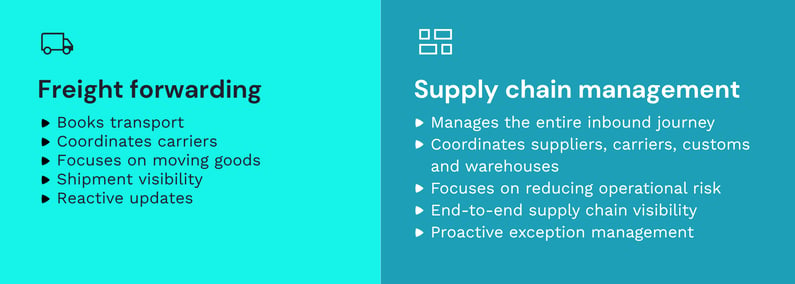
Rather than focusing solely on transportation, it considers how suppliers, freight, customs, warehousing and fulfilment work together as one connected process.
Think of freight forwarding as managing a journey.
Supply chain management manages everything that makes that journey successful.
A freight forwarder might tell you your container will arrive next Tuesday.
A supply chain partner asks whether your warehouse has enough labour booked, whether customer orders will be affected, whether inventory needs reallocating and whether alternative actions should be taken before the shipment even arrives.
Both services are valuable. The difference lies in how much ownership a provider takes beyond transportation itself.
Why integrated logistics reduces operational risk
Every additional supplier, carrier and software platform introduces another point where information can be delayed, duplicated or lost. Over time, these small inefficiencies become accepted as part of everyday operations.
-
Teams spend hours chasing updates.
-
Warehouse managers rely on spreadsheets instead of live information.
-
Customer service contacts carriers for delivery updates.
-
Operations teams manually reconcile data between different systems.
None of this activity directly creates value. It just compensates for disconnected processes. An integrated logistics model removes many of these friction points by giving everyone access to the same operational picture.
Instead of asking, "Where's my shipment?" businesses can ask much more useful questions:
-
"Will this affect customer orders?"
-
"Do we need to adjust warehouse labour?"
-
"Should inventory be prioritised differently?"
-
"Can we resolve this before it becomes a problem?"
This shift from reactive tracking to proactive decision-making is where integrated supply chains deliver their greatest value. Visibility isn't more than just knowing what's happening. It’s having enough notice to change the outcome.
Five questions to ask your freight forwarding provider
Choosing a freight provider is about more than comparing shipping rates or transit times. The right partner should help you build a more resilient, transparent and efficient supply chain, not just move goods from one location to another.
Before committing to a provider, ask these five questions to understand how they support your wider operations.
1. How will I know if something goes wrong?
Every shipment carries some level of risk. Weather events, port congestion, customs inspections and supplier delays are all part of international trade. What matters is how quickly you're informed and what happens next.
A good freight provider shouldn't wait until you ask for an update. They should proactively notify you of delays, explain the likely impact and outline the options available to minimise disruption.
Ask whether you'll receive milestone updates, exception alerts and revised estimated arrival dates. The earlier you know about a potential issue, the more time you have to adjust warehouse labour, customer expectations or inventory planning.
2. Do you manage communication with my suppliers?
Many delays begin before goods are collected.
Production schedules change, paperwork isn't completed on time, or collections need to be rescheduled. If your freight provider only becomes involved once cargo is ready, you're missing a valuable opportunity to improve visibility.
Look for a partner that works directly with your suppliers, coordinating collection dates, confirming documentation and identifying potential issues before they affect transit times.
Strong supplier communication often prevents problems before they occur.
3. How do you handle customs and compliance?
Customs delays can be costly, particularly when shipments are time-sensitive or destined for multiple markets.
While no provider can eliminate every customs inspection, they should have robust processes in place to ensure documentation is accurate, complete and submitted on time.
Ask who prepares customs paperwork, how discrepancies are resolved and what support is available if additional information is requested. A proactive approach to compliance helps reduce unnecessary delays and gives you greater confidence when expanding into new markets.
4. What level of visibility will I receive?
Not all shipment tracking is created equal.
Basic tracking may tell you when a shipment has departed or arrived, but it doesn't always provide the operational context your business needs.
For example, if a shipment is delayed by five days, can you quickly understand which purchase orders are affected? Will your warehouse team know when to adjust labour planning? Can customer-facing teams update delivery expectations with confidence?
Meaningful visibility goes beyond tracking milestones. It helps you make informed decisions across your wider operation.
5. Do you move freight, or help manage my supply chain?
This is perhaps the most important question of all.
Some providers focus exclusively on transportation. Others take a broader role, helping coordinate suppliers, freight, customs, warehousing and fulfilment as part of a connected supply chain.
If your logistics operation relies on multiple providers working independently, consider whether a more integrated approach could reduce administration, improve communication and provide greater operational resilience.
The best logistics partners not only deliver shipments, but they also help your business operate more effectively.
How to improve inbound supply chain visibility
Improving visibility doesn't necessarily require a complete overhaul of your supply chain. In many cases, it's about creating better connections between existing people, processes and platforms.
The first step is understanding where visibility is currently being lost.
-
For some businesses, this happens at supplier level, where production updates are shared inconsistently or not at all.
-
Others struggle with fragmented communication between freight providers, customs brokers and warehouse teams.
-
In many organisations, information exists, it just isn't reaching the right people at the right time.
Once these gaps have been identified, there are several practical ways to improve inbound visibility.
Standardise supplier communication
Agree clear expectations with suppliers around production updates, collection readiness and documentation timelines. Consistent reporting makes it easier to identify delays before they affect downstream operations.
Share information across departments
Inbound logistics shouldn't operate in isolation. Warehouse teams, procurement, customer service and commercial teams all benefit from having access to the same shipment information. Breaking down internal silos reduces duplicated effort and improves decision-making.
Measure the right KPIs
Visibility is only valuable if it's measurable. Consider monitoring metrics such as:
-
Supplier on-time readiness
-
Inbound delivery performance
-
Customs clearance times
-
Shipment exception rates
-
Forecast accuracy
-
Warehouse labour utilisation against planned arrivals
Rather than measuring individual activities, these indicators provide a clearer picture of how effectively your inbound supply chain is performing.
Invest in connected technology
Modern logistics platforms make it easier to consolidate shipment updates, supplier communications and warehouse planning into a single source of truth. The goal isn't to generate more data. It's to make sure everyone is working from the same information, reducing manual updates and improving confidence in operational decisions.
Work with partners who collaborate
Technology alone won't solve visibility challenges. The most successful supply chains are built on strong relationships between suppliers, logistics providers and fulfilment partners. Open communication, shared objectives and proactive problem-solving often deliver greater improvements than software alone.
"True supply chain visibility gives businesses confidence. When you can see what's happening across your inbound journey, you can plan ahead, reduce risk and respond to issues before they impact your customers." — Antony Day, Global Logistics and Carrier Manager, IFGlobal.
When every stakeholder understands what's happening across the inbound journey, businesses spend less time reacting to problems and more time planning for growth.
How IFGlobal connects your supply chain
At IFGlobal, we believe warehouse performance starts long before inventory arrives at the loading bay. That's why our Supply Chain Support service extends beyond traditional freight forwarding to provide greater visibility across the entire inbound journey.
Rather than treating suppliers, transportation, customs and warehousing as separate activities, we help connect them into a single, coordinated process.
Our team works closely with manufacturers, freight partners and internal warehouse operations to ensure information flows as smoothly as your products do. From collection planning and shipment coordination through to customs support and warehouse scheduling, we focus on reducing uncertainty at every stage.
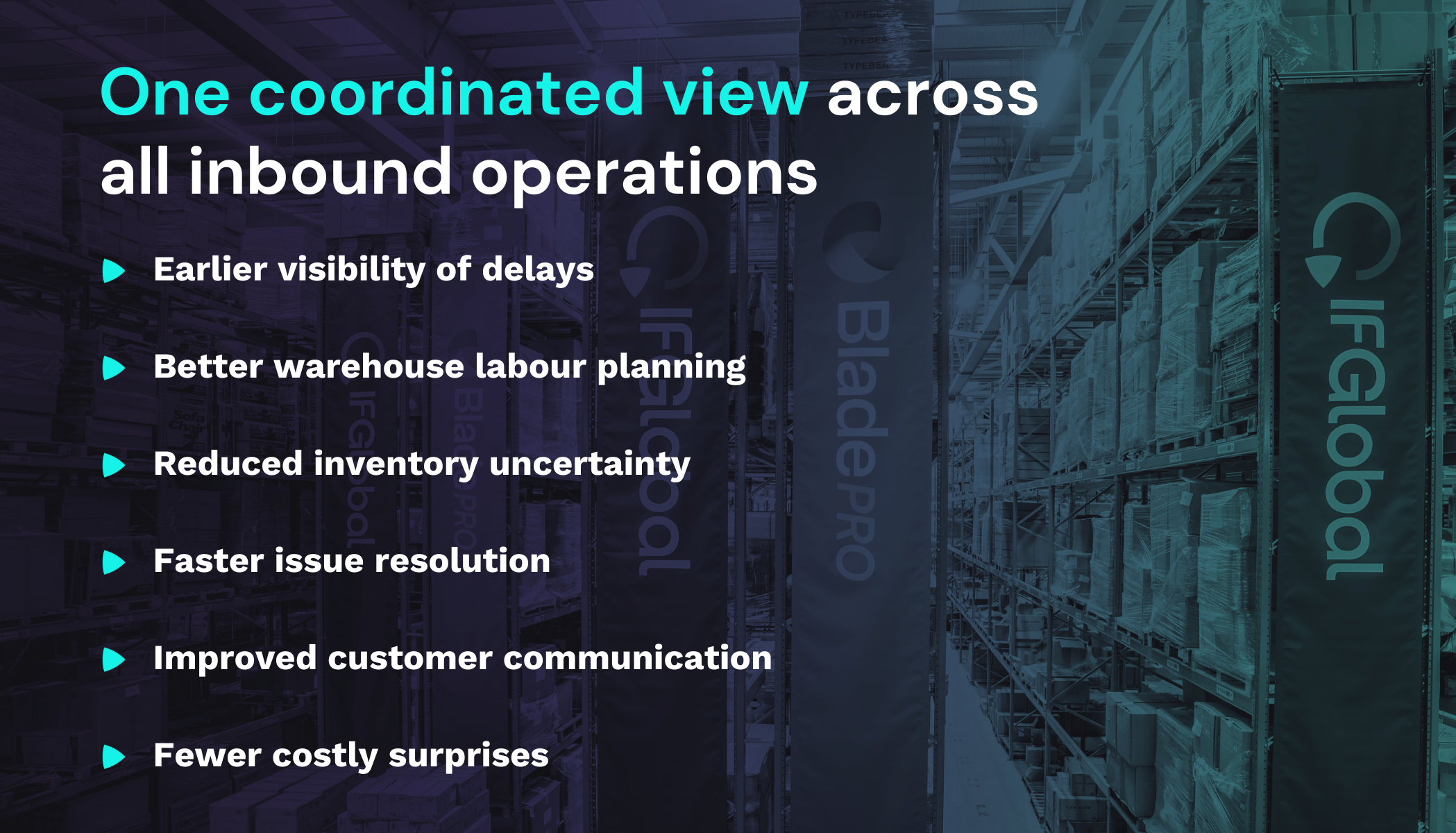
This joined-up approach gives businesses earlier visibility of potential delays, helping warehouse teams plan labour more effectively, customer service teams communicate with confidence, and operational leaders make informed decisions before disruption escalates.
For businesses managing multiple suppliers or shipping internationally, this can significantly reduce the administrative burden associated with coordinating different providers.
Instead of chasing updates across multiple organisations, you have a single partner helping to oversee the movement of goods from origin through to fulfilment.
Whether you're importing full container loads, managing regular replenishment or expanding into new international markets, our goal is simple: to provide the visibility and support you need to keep your supply chain moving.
When every stage of the inbound journey is connected, fulfilment becomes more predictable, customer experience improves and your business is better equipped to respond to change.