


GLOBAL BRANDS LOOKING FOR UNIFIED FULFILMENT



Businesses don’t suddenly realise they've outgrown their 3PL overnight.
Typically, growth introduces new demands that make fulfilment harder to manage, from manual workarounds and disconnected data to increasing operational inefficiencies. Nothing may feel fundamentally broken, but running the operation requires more involvement than it once did.
Key takeaways
- Outgrowing a 3PL is usually driven by complexity rather than volume.
- The first signs often appear when existing systems, processes and support begin struggling to keep pace with growth.
- A difficult peak season, higher fulfilment costs or rapid growth aren’t necessarily reasons to switch providers.
- The strongest fulfilment partnerships evolve alongside the business and help plan for what’s next, not just process today’s orders.
- Looking at the overall health of the operation is often more useful than focusing on individual issues.
Why businesses start questioning their 3PL
At some point, many growing businesses ask the same question, "is our current 3PL still right for us?".
It’s not always triggered by one major issue. Usually, it's a collection of small frustrations that start appearing across the operation.
Launching a new product takes longer than expected. Adding a new sales channel creates unexpected complexity. Inventory suddenly has three versions of the truth depending on what system you look at.
The operation still works, but managing it is becoming increasingly demanding.
For many brands, that's where the concern starts. Time that should be spent on growth is being absorbed by day-to-day operational management. And it's a challenge many businesses are facing. PwC found that 82% of operations and supply chain leaders struggle to balance short-term operational demands with longer-term strategic change.
The difficult part is working out whether these pressures are simply the result of a growing business or an indication that your fulfilment operation is starting to hold that growth back.
The operational signs that mean you've outgrown your 3PL
Growth has a habit of exposing the cracks in your operation. The brands that come to us looking for a new fulfilment partner have usually seen a few of these warning signs already.
Operational complexity is creating friction
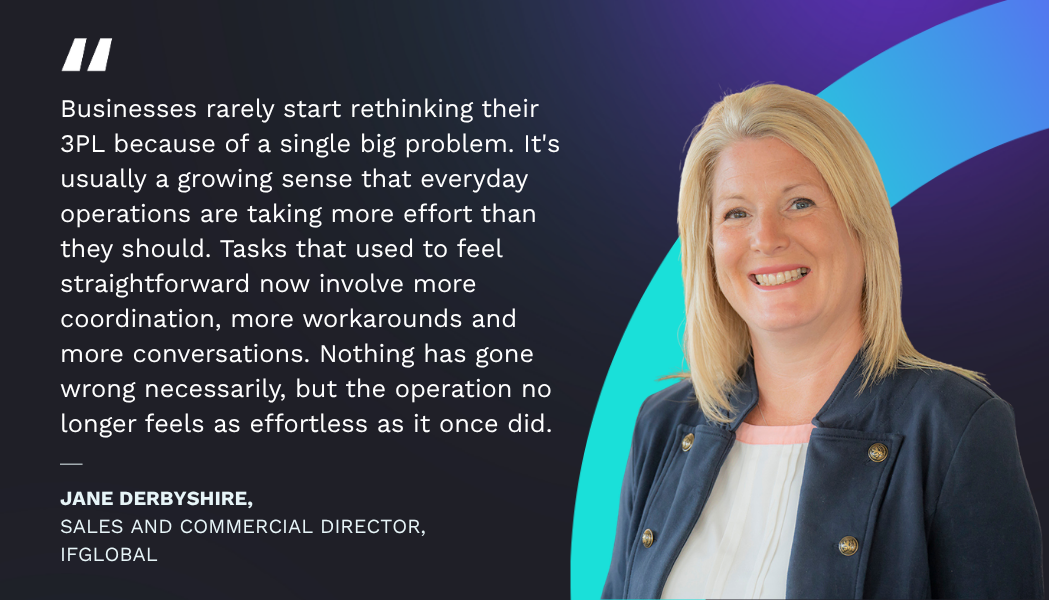
You can usually feel this one before you measure it. Nothing’s falling apart yet. It’s just not flowing. Launching a new product, adding a sales channel or running a promotion suddenly involves far more coordination than it used to.
There’s more checking, more chasing and more conversations to make sure everyone’s working from the same information. When simple tasks start feeling complicated, it's often a sign your operation hasn't scaled as smoothly as the business around it.
Technology has become a bottleneck
At first, your systems keep up with the business. Reports are easy to pull. Information is where you expect it to be. Everyone’s working from the same view of the operation.
Then the business grows. A new sales channel is added. Product ranges expand. More people need access to more information. What once felt straightforward starts becoming harder to manage.
We've seen teams exporting reports from one system, checking stock in another and manually reconciling the numbers before they're confident enough to act.
And it’s not an uncommon issue. According to Gartner, 40% of logistics leaders say getting value from existing technology investments is one of their biggest digital logistics challenges.
When accessing reliable information becomes difficult, technology can quickly shift from an enabler of growth to a source of inefficiency.
Service levels are getting harder to maintain
Most fulfilment operations look good when things are running smoothly.
The real test comes when orders ramp up. A promotion performs better than expected. A retailer places a larger order. A new product launch generates more demand than forecast.
Increased demand is great for the business, until the operation starts feeling the strain.
Dispatch times slip. Customer enquiries increase. Teams spend more time firefighting than fulfilling. If every spike in demand creates pressure across the operation, it’s worth understanding what’s causing it.
Capacity can no longer support your growth plans
Outgrowing your warehouse capacity can happen surprisingly quickly.
An influencer mentions your product. A marketing campaign goes viral. A new product launch becomes a big success. Overnight, demand can scale beyond what your warehouse can manage.
At first, it feels like a good problem to have. Until cracks start appearing in your fulfilment operation.
Storage space becomes tighter. Inbound stock takes longer to process. Dispatch queues start building during busy periods. What used to run smoothly now needs careful planning just to keep moving.
If every growth opportunity comes with questions about whether the warehouse can cope, it may be a sign your fulfilment setup is reaching its limits.
The relationship has become transactional
This is probably the easiest sign to miss.
Everything still works. Orders go out. Customers get their deliveries. Service levels are consistent. The issue is that while you’re focused on where the business is going next, your 3PL is focused on processing today’s orders.
The strongest fulfilment partnerships feel like an extension of the team. They know what's coming, help you think ahead and spot opportunities, and address potential issues before they become problems.
If most conversations focus on today's orders rather than next quarter's plans, it may be worth asking whether the partnership is delivering the strategic support the business now needs.
The signals that don't necessarily mean you've outgrown your 3PL
Not every operational challenge is a sign you've outgrown your 3PL.
We regularly speak to businesses that think their provider is the problem, only to discover they're experiencing the same challenges many growing brands face.
Before making a decision, it's worth understanding the difference between normal growing pains and signs that your fulfilment operation genuinely isn't keeping up.
Order volumes have increased
This is probably the most common reason brands start questioning their 3PL.
Orders are flying in. The warehouse is busier. Customer service is getting more enquiries. Everything feels a little more chaotic.
It's easy to look at that and think, "we've outgrown our 3PL." But a busier operation isn’t necessarily a broken one.
Helping businesses handle growth is what a 3PL is there for. If orders are still going out on time, service levels remain consistent and customers aren't feeling the strain, rising volumes are usually a sign the operation is doing exactly what it should.
Peak season was difficult
Let’s be honest, peak season puts even the best fulfilment setups under pressure.
Every fulfilment centre is busier. Every carrier network is under pressure. Every ecommerce team is watching sales, stock and shipping updates more closely than usual. That’s just peak.
A difficult few weeks doesn’t automatically mean you’ve outgrown your 3PL.
What’s more revealing is what happens when the dust settles. Did the operation bounce back? Were problems communicated clearly? Were lessons learnt that will help next peak run more smoothly?
The best fulfilment partners don't just survive peak. They come back better prepared for the next one.
Fulfilment costs are rising
Nobody likes seeing costs go up. Especially when you’re seeing plenty of providers promising lower rates. But rising costs are often a by-product of growth.
You’re holding more stock. Shipping more orders. Expanding into new markets. Your fulfilment partner is working harder for your brand.
So, while rising costs are frustrating, they’re not automatically a warning sign. A cheaper quote might save money on paper, but it's worth considering what other costs could surprise you later down the line before making the switch on price alone.
Growing pains or signs you've outgrown your 3PL
Not every operational challenge means you've outgrown your 3PL.
Every business experiences busy periods, unexpected demand and changing priorities. The difference is how easily the operation adapts when those pressures appear.
The table below can help separate normal growing pains from the signs that you've genuinely outgrown your 3PL.
| Challenge | Normal growing pains | Potential signs you've outgrown your 3PL |
| Rising order volumes | Service levels remain consistent | Service levels declines as order volumes grow |
| Peak season pressure | Operations recover quickly | Issues continue long after peak |
| New sales channels | Systems adapt easily | Manual workarounds become common |
| Business growth | Capacity supports expansion | Growth plans are limited by operations |
A framework for evaluating your current 3PL
If you're trying to work out whether you've outgrown your fulfilment partner, it's easy to get distracted by the occasional headache.
A delayed dispatch. A difficult peak. One too many frustrating conversations.
The problem is that none of those things tell the full story on its own. Some challenges are a normal part of growth. Others point to underlying limitations within the fulfilment operation.
That's where taking a step back and looking at the overall health of the operation becomes so important.
One useful way to evaluate your current provider is to look at five key areas: scalability, capability, accuracy, leadership and enablement.
| SCALE area | Questions to ask | Why it matters |
| Scalability | Can they support where the business will be in 2-3 years not just where it is today? | Growth plans only works if your fulfilment operation can grow with them. |
| Capability | Can they handle the increasing complexity of our operation? | More channels, products and customers require more sophisticated fulfilment. |
| Accuracy | Are service levels staying consistent as we grow? | Reliable fulfilment is essential for customer experience and operational confidence. |
| Leadership | Are they helping us think ahead, or simply processing orders? | The best 3PLs provide insight, advice and support beyond the day-to-day. |
| Enablement | Does their technology make it easier to run and grow a business? | Visibility, automation and accessible data help teams move faster and make better decisions. |
Sometimes the answers are reassuring. Other times they highlight challenges you've probably been noticing and trying to ignore.
Either way, you'll have a much clearer picture of whether your current provider is still the right fit. And if the answer is no, our ultimate guide to choosing an ecommerce fulfilment partner can help you select the 3PL that's built for your next stage of growth.
.png?width=1049&height=600&name=IFGlobal%20Blog%20Graphics%20Template%20(2).png)
What the right move looks like: Sandbanks
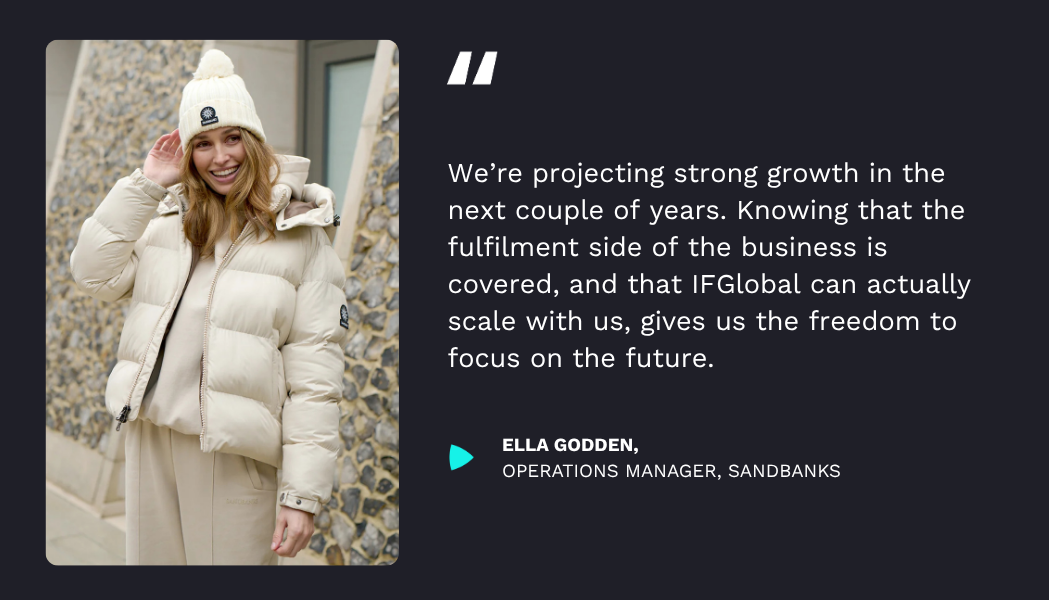
For Sandbanks, the signs didn’t appear overnight.
Like many growing brands, they simply reached a point where their fulfilment setup was taking up more of their time and attention than it should.
Warehouse space was tight. Stock visibility wasn’t clear. Manual processes were making everyday tasks harder than they needed to be. Overall, fulfilment was becoming something the team had to actively manage rather than rely on.
Sandbanks needed more space, better visibility and an operation that could support growth without creating more complexity along the way. And that’s exactly what we gave them.
From reliable inventory data and greater operational flexibility to a tailored fulfilment setup and proactive support, partnering with IFGlobal gave Sandbanks the foundations they needed to scale with confidence.
What growth focused fulfilment looks like
At IFGlobal, we make sure your operation never becomes the thing holding your business back.
That starts with visibility. Our Fulfilment Operating System, BladePRO, connects every part of the fulfilment journey in one place, giving brands clearer operational oversight, smarter workflows and access to the information they need to make confident decisions.
It also means having the infrastructure to support what’s next. With fulfilment centres across the UK, US and EU, our global fulfilment network helps brands scale into new markets, serve customers closer to home and continue growing without having to rethink their entire operation.
Combined with more than 20 years of fulfilment experience and dedicated operational support, our focus is on helping brands grow with confidence, wherever that growth takes them.