


GLOBAL BRANDS LOOKING FOR UNIFIED FULFILMENT



Better retention should make life easier. Customers stay longer, revenue becomes more predictable and growth starts compounding. The catch is that every renewal creates another fulfilment commitment and, for many subscription brands, that's exactly where fulfilment starts feeling the strain.
Key takeaways
- Fulfilment pressure often builds gradually, long before service levels start slipping.
- Strong retention can make forecasting, inventory planning and operational capacity harder to manage.
- What feels scalable at one stage of growth can quickly become stretched as subscriber numbers increase.
- The biggest fulfilment challenges are usually caused by a collection of small pressures rather than one major issue.
- Brands that plan for retention success early are better positioned to scale without disruption.
Retention success changes the rules of fulfilment
Subscription models have become a familiar part of everyday life. According to Forrester's 2025 research, half of US online adults have four or more monthly subscriptions. For brands, that creates a significant opportunity. More customers sticking around means more predictable revenue, higher lifetime value and a stronger platform for growth. What often gets overlooked is the operational impact.
Every customer who renews creates another order to forecast, another shipment to fulfil and another customer relationship to support.
At first, you barely notice. A few extra subscribers here and there doesn't change much. Orders keep going out and everything feels under control.
Then retention starts doing its job. Subscriber numbers build month after month, forecasts need more attention and teams spend longer managing the operation than they used to.
We regularly see brands reach this stage. There aren’t any major alarm bells ringing. In fact, the business is often performing well. But it's taking a lot more effort to keep everything running smoothly than it did six months ago. That's usually the first sign that retention is changing the demands placed on the business.
Where retention creates pressure behind the scenes
Better retention often sneaks up on fulfilment teams.
Nothing suddenly goes wrong. Orders keep leaving the warehouse. Customers keep renewing their subscriptions. But little things start to become more noticeable.
Inventory planning gets more complicated
Forecasting is one of those things that feels straightforward until it doesn't.
When retention improves, products move through the business differently. Customers stay longer, demand builds and suddenly a forecast that looked sensible a few months ago doesn't feel quite so reliable.
What looked like healthy stock levels can start disappearing much faster than expected. And because subscription customers expect consistency, running out isn't really an option.
Warehouse capacity starts getting tested
More subscribers means more recurring orders moving through the fulfilment journey every cycle.
The warehouse might be doing exactly what it's always done. The difference is that it's now doing it for a growing number of customers every single month.
You don't always notice it immediately. Then a promotion performs better than expected. A product launch lands particularly well. Peak season arrives.
That's often when capacity gets put under pressure.
Customer expectations grow with subscriber numbers
More subscribers naturally create more delivery enquiries, address changes and account updates. None of this is unusual. It's simply part of having a larger customer base.
On its own, an increase in customer enquiries is manageable. Alongside everything else that's growing, it can quickly become another source of pressure.
The workarounds start piling up
This is probably the easiest sign to miss. Most growing businesses have a few workarounds. A spreadsheet someone relies on. A report that's manually checked. A process that takes three steps when it probably should take one.
None of these things feel particularly concerning on their own.
The problem is that the processes built for a few thousand subscribers can start feeling surprisingly fragile when they're supporting tens of thousands.
Why retention can expose weaknesses you never knew you had
Growth has a habit of revealing things that were easy to ignore before.
A stock discrepancy that affects five customers might barely register. The same issue affecting hundreds of subscribers feels very different.
That's why fulfilment often starts feeling harder once retention improves. The margin for error gets smaller. Supplier delays carry more risk. Forecasting becomes more important. Operational inefficiencies become more visible. And the stakes are high. PwC's 2025 Customer Experience Survey found that 52% of consumers have stopped buying from a brand after a bad product or service experience.
At that point, fulfilment is no longer just an operational consideration. It's a critical part of customer retention.
What changes when retention gets good?
It's easy to assume fulfilment tomorrow will look much like fulfilment today. Then retention improves.
The operation might look the same from the outside, but underneath, the demands placed on it can be very different.
| At 1,000 subscribers | At 10,000 subscribers |
| One stock issue is manageable |
One stock issue affects hundreds of customers |
|
Forecasting errors have limited impact |
Forecasting errors become expensive |
|
Manual processes still work |
Manual processes start to break down |
|
Customer service can absorb problems |
Customer service volumes increase rapidly |
|
Fulfilment reacts to demand |
Fulfilment must anticipate demand |
This is usually the point where businesses start noticing that what worked before isn't working quite as comfortably as it once did.
Five signs you've outgrown your subscription fulfilment model
It's not always obvious when a fulfilment operation is reaching its limits. Usually, you can feel it before you can measure it.
1. Forecasts are becoming harder to trust
Inventory plans seem to need constant tweaking. Stock requirements are becoming less predictable. Forecasts that once felt reliable suddenly need more attention.
That's often a sign the business is growing faster than the forecasting process supporting it.
2. Stock availability is becoming a recurring issue
The occasional stock issue can happen to any business. The problem is when it stops feeling occasional.
If inventory constantly feels tighter than it used to, subscriber growth may be putting more pressure on the operation than expected.
3. Operational workarounds are becoming the norm
Most growing businesses pick up the odd workaround as they grow.
When those shortcuts become essential to keeping things running, it's often worth asking whether the operation has evolved at the same pace as the business.
4. Customer service volumes keep increasing
Strong retention naturally leads to more customer interactions. More customers means more delivery questions, more subscription updates and more opportunities for things to go wrong.
If enquiries are increasing faster than expected, it could be pointing towards pressure elsewhere in the fulfilment journey.
5. Every peak feels harder than the last
A well-scaled fulfilment operation should be able to absorb seasonal spikes, promotions and product launches without everything feeling like a firefighting exercise.
When periods of increased demand consistently expose bottlenecks, it can be a sign that the operation is struggling to keep pace.
None of these problems are unusual for growing subscription brands. The important part is recognising them before they begin affecting service levels and customer experience.
Questions every growing subscription brand should ask
As subscription volumes scale, it's worth taking a step back and looking at the operation supporting them.
The signs of strain aren't always obvious, especially when the business is performing well. These five questions can help highlight whether the operation is ready for what's coming next.
| Question | Why it matters |
|
What happens if retention exceeds forecast? |
Success shouldn't create chaos |
|
Where would pressure appear first if subscriber numbers doubled? |
Bottlenecks become more obvious as volumes grow |
|
How reliant are we on manual workarounds? |
Processes that rely on fixes rarely scale smoothly |
|
Can we absorb peaks, launches and unexpected demand? |
Growth exposes weaknesses quickly |
|
How quickly can we identify and respond to problems? |
Operational visibility becomes more important to scale |
The answers might validate your current approach, or they might reveal a few cracks beginning to form. Understanding where pressure is building is often the first step towards preventing bigger problems later on.
How SURI scaled subscription fulfilment without compromising the customer experience
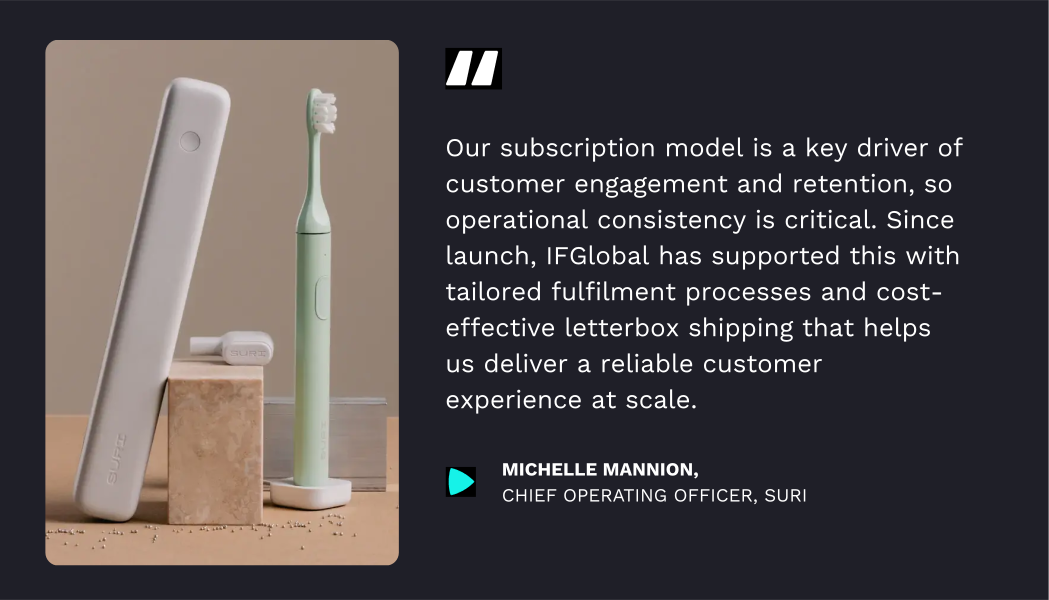
SURI partnered with us from day one, and subscription fulfilment has always been central to its growth strategy.
Like most brands offering a subscription service, the goal was simple: keep customers happy and keep them coming back.
As subscriber numbers grew, so did the volume of recurring orders moving through the operation each month. More subscribers meant more inventory to manage, more forecasting decisions to get right and more customer expectations to meet.
Because we'd been supporting SURI from the start, the focus wasn’t simply on managing today’s volumes. It was about preparing for tomorrow’s.
That included introducing tailored subscription fulfilment processes and a letterbox-friendly shipping solution designed to keep costs commercially viable while maintaining the customer experience subscribers had come to expect.
Rather than waiting for growth to expose operational weaknesses, we made sure the fulfilment operation was ready before they appeared.
Why subscription brands turn to IFGlobal
Most subscription brands don't come to us because they're struggling. They come to us because they're growing.
Retention is up. Subscriber numbers are climbing. Everything looks positive.
Then somebody realises all that growth needs forecasting, inventory, fulfilment cycles and thousands of recurring orders managed every single month. That's usually when fulfilment moves from being a back-office function to a boardroom conversation.
We've spent more than 20 years helping brands navigate that shift by building fulfilment operations designed around recurring demand. Our cycle-based workflows keep subscription orders moving on schedule, while our inventory forecasting helps brands stay ahead of demand rather than constantly reacting to it.
And because subscription growth rarely follows a perfectly straight line, our fulfilment model is built to flex. When volumes spike, product launches exceed expectations or retention performs better than the forecast, the operation is ready to keep pace.
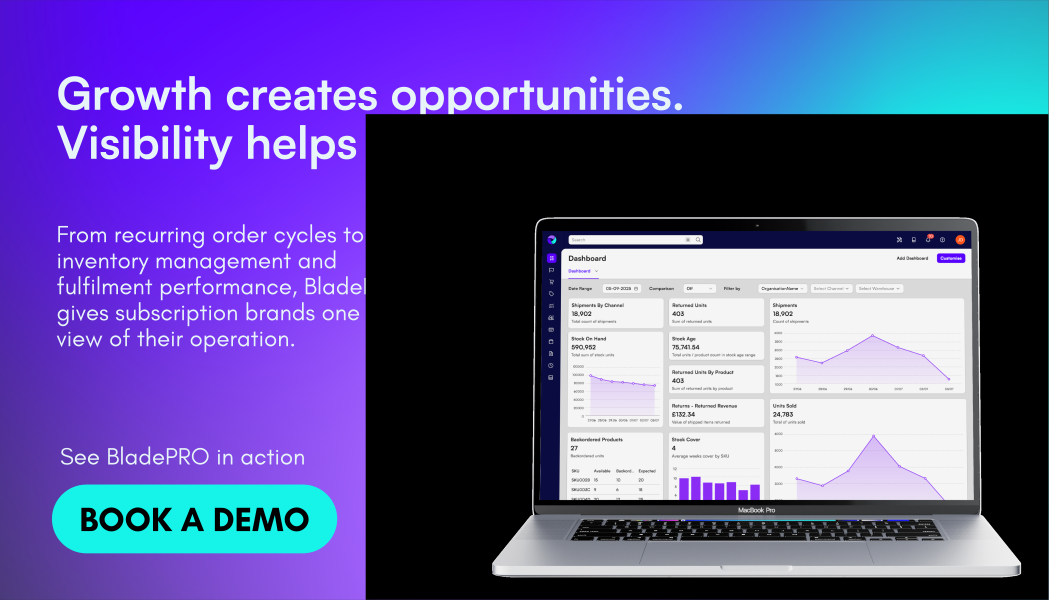
Behind it all is our Fulfilment Operating System, BladePRO, giving brands real-time visibility across orders, inventory and shipments. The result is fewer surprises, better planning and a much clearer picture of what's happening across your fulfilment.
The brands that scale most successfully are usually the ones that prepare for growth before it arrives, strengthening the foundations behind the business before their operation starts feeling the strain.
That's exactly where the right fulfilment partner makes all the difference.