


GLOBAL BRANDS LOOKING FOR UNIFIED FULFILMENT



For many growing ecommerce brands, manual processes aren’t a strategic decision that get made. They’re just ‘how things have always been’. Orders are exported into spreadsheets. Inventory tracking is done in CSV files. Returns are logged by hand. Reports are compiled at the end of the week, if there’s time. At lower volumes, it’s just about manageable. But as order numbers climb and channels multiply, those same processes quietly become a constraint on growth.
Enterprise ecommerce teams rarely fail because of a lack of ambition, tools or data. They struggle because of manual processes buried deep inside daily operations that are slowing execution, increasing risk and keeping teams in reactive mode.
We see this pattern regularly. Brands come to us focused on scaling, only to discover that their biggest barrier is operational drag.
In this article, we explore what’s really holding teams back and how to move from manual friction to structured, scalable fulfilment.
In this article
Modern tech stack, manual execution
On paper, many ecommerce businesses look digitally mature. They’re running platforms like Shopify or BigCommerce, using marketing automation tools, ERPs and reporting dashboards, but behind the scenes, execution often still looks like:
-
Operations teams exporting and reconciling order data manually. Orders are downloaded, reformatted and uploaded into warehouse systems. Marketplace sales are checked against inventory reports in spreadsheets. Instead of a single, connected flow, teams are acting as the integration layer.
-
Merchandising teams updating product attributes across multiple systems. Product descriptions, dimensions, barcodes and compliance data are edited in one platform, then manually mirrored in others, introducing inconsistency and increasing the risk of listing errors.
-
Customer service switching between tools to resolve a single query. A simple “where’s my order?” request might require checking the ecommerce platform, courier portal, inventory system and internal notes. Response times increase and CX teams become reactive rather than proactive.
-
Inventory discrepancies corrected in spreadsheets. Cycle counts reveal mismatches. Adjustments are logged offline. Root causes are rarely tracked systematically, so issues reoccur.
-
Leadership waiting days for consolidated reporting. Data is pulled from multiple sources, manually combined and validated before it’s decision-ready. By the time insights reach their destination, they’re already out of date.
None of these tasks are technically broken. They’re just slow, fragile and dependent on human intervention. And as volume increases, the cracks begin to show.
“One of the first things we notice when onboarding a new client is how much of their system lives in spreadsheets and inboxes. As soon as volumes increase or a retailer adds new compliance requirements, those manual processes start creating delays and unnecessary costs. Our role is to remove that operational friction so their team can focus on growth, not firefighting.”- Dom Webb, Account Management Lead, IFGlobal.
|
We now offer fulfilment admin support so you can keep your team focused on growth while we keep orders moving. Our dedicated team takes care of the manual tasks, retailer-specific requirements and process-heavy execution that sit around your order flow. Learn more > |
The true cost of manual fulfilment
Manual processes rarely appear as a clear line item on a P&L statement, but their impact is very real, and cumulative.
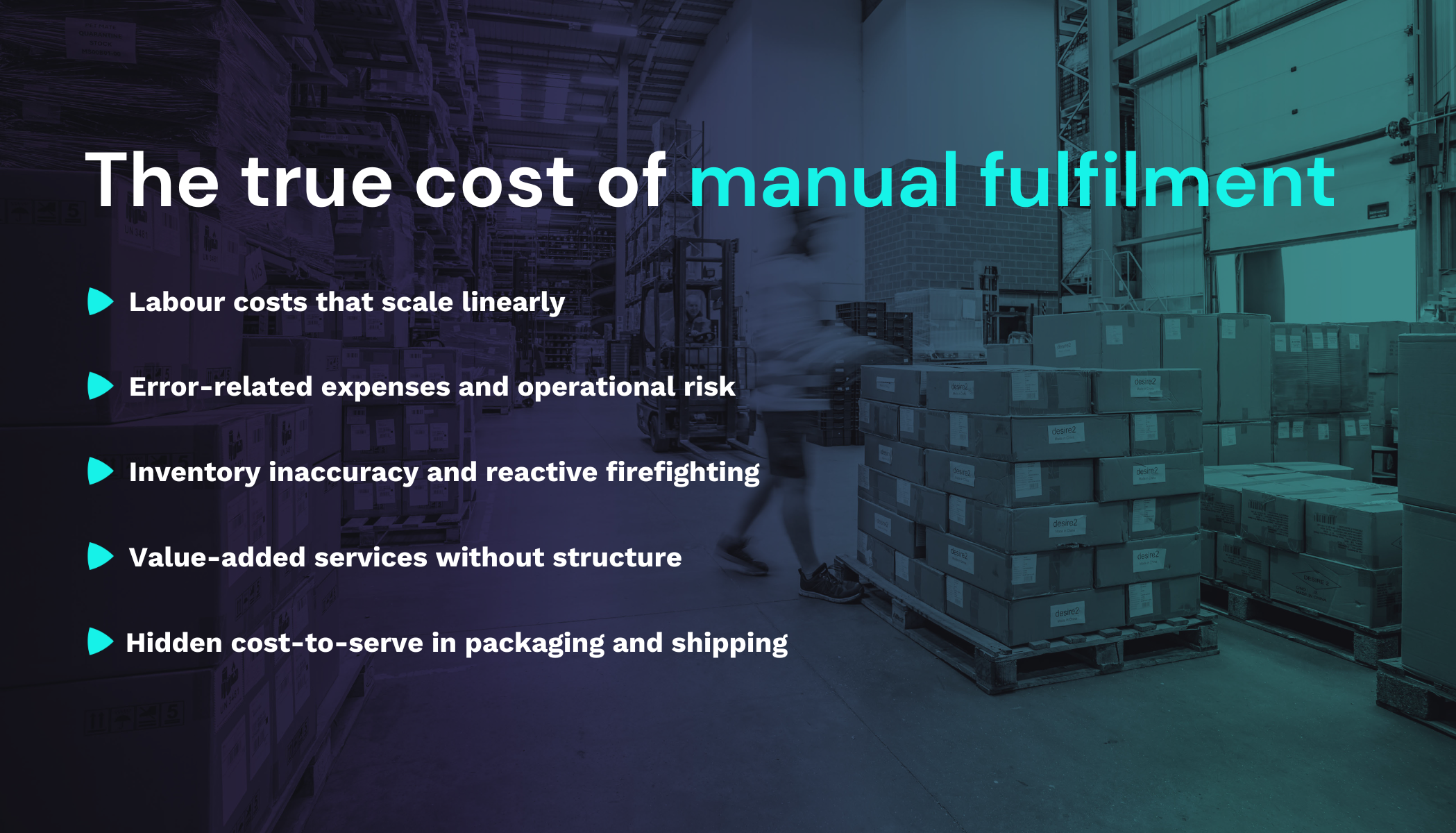
1. Labour costs that scale linearly
Manual order entry, exception handling, relabelling, returns processing and ad hoc reporting all consume hours of your team’s time. According to a study by the American Productivity & Quality Center (APQC), in some B2B environments, manually processing a single purchase order can cost between $50 and $150 when labour, error correction and admin time are factored in.
Manual systems are linear:
-
To double output, you double headcount.
-
To handle peak, you pay overtime.
-
To fix errors, you divert your best people from growth-driving work.
Technology, by contrast, scales with volume, not payroll. This is where our proprietary fulfilment operating system, BladePRO, changes the model. BladePRO connects order channels directly to our warehouse operations, automating order routing, status updates and inventory synchronisation in real time. Instead of exporting and rekeying data, orders flow seamlessly from checkout to pick, pack and dispatch.
For brands, that means fewer manual touchpoints, reduced admin overhead and a fulfilment operation that grows without requiring proportional increases in internal resource.
2. Error-related expenses and operational risk
Manual processes increase the likelihood of:
-
Incorrect shipments – wrong SKUs picked due to misread lists or outdated data.
-
Address errors – manually edited delivery details leading to failed deliveries.
-
Duplicate orders – caused by delayed sync between systems.
-
Refunds and reshipments – triggered by avoidable picking or data-entry mistakes.
-
Stock discrepancies – inaccurate system counts resulting in oversells or backorders.
One mistyped SKU can trigger a cascade: return shipping, restocking, customer service time and potential churn.
For brands competing against the fulfilment standards set by Amazon, even small inconsistencies can erode customer trust. Customers don’t often compare you to businesses your size, but to the fastest, most accurate delivery experience they’ve had.
At IFGlobal, we mitigate this risk through barcode-driven warehouse processes, structured quality control checks and real-time system validation through BladePRO. The objective is simple: accuracy by design, not correction after the fact.
3. Inventory inaccuracy and reactive firefighting
Even minor gaps in inventory accuracy can cause major disruption:
-
Overselling unavailable SKUs – damaging customer confidence and increasing refund volume.
-
Delayed shipments – as teams locate or reallocate stock.
-
Manual reallocation of stock between channels – increasing admin and risk.
-
Increased customer service tickets – from delayed or split shipments.
-
Emergency replenishment costs – including expedited inbound freight.
Without real-time visibility and structured reconciliation processes, teams are forced into reactive mode. Inventory control is about more than stock levels. It’s about speed, reliability and confidence in decision-making.
Through BladePRO, our clients benefit from live inventory visibility and automated stock updates across channels. That means fewer surprises, better forecasting and the confidence to launch campaigns without fear of overselling.
“In B2B fulfilment, small inaccuracies create big consequences. A missed routing label or incorrect carton configuration can trigger chargebacks that wipe out margin on an entire order. That’s why structured processes and real-time visibility are so valuable. The right operational framework protects both profitability and brand reputation.” - Paul Lavin, Operations and Transformation Director, IFGlobal.
4. Value-added services without structure
Kitting, retail prep, promotional builds, subscription assembly and rework are essential for many ecommerce and B2B brands. But when these processes are not clearly scoped and documented, they become unpredictable labour costs.
Watch for:
-
“Non-standard” task charges
-
Hourly labour that fluctuates month to month
-
Returns handling not clearly priced
-
Repeated re-quoting for recurring activities
When value-added services lack operational structure, forecasting becomes guesswork. At scale, that uncertainty compounds.
At IFGlobal, our value-added services are built into clearly defined workflows. From retail-compliant labelling and B2B order prep to subscription box assembly and promotional kitting, tasks are scoped, documented and priced transparently.
We also provide fulfilment admin support, acting as an operational extension of your team so your internal resource can focus on product development, marketing and brand growth, rather than managing day-to-day operational queries.
5. Hidden cost-to-serve in packaging and shipping
Quotes often assume standard packaging and straightforward shipping logic, but the reality of modern ecommerce is more complex.
-
Branded unboxing experiences that require custom materials and additional handling
-
Personalised inserts or marketing collateral
-
Fragile or regulated goods needing specific packaging standards
-
Multi-zone distribution affecting carrier cost models
-
B2B retailer routing requirements and compliance documentation
If these operational realities aren’t modelled correctly from the outset, fulfilment remains technically functional but financially inefficient. Understanding the true cost to serve per order is essential to protecting margin as volume grows.
Through our solutions partner programme, we collaborate with specialist providers such as Supplied Agency for packaging solutions, and Yuzu for personalised inserts, to help brands elevate the unboxing experience without losing control of operational cost. By integrating these services into structured fulfilment workflows, we ensure experience and efficiency move in step.
Why manual workflows persist
Despite clear drawbacks, many ecommerce teams still rely heavily on manual processes due to:
-
Comfort with familiar tools like spreadsheets
-
Lack of time to redesign workflows
-
Perceived complexity or cost of technology
-
Disconnected systems across departments
-
Growth outpacing operational infrastructure
In fast-moving environments, process improvement often takes a back seat to immediate execution. But over time, the opportunity cost becomes significant, and manual inefficiencies in one place can become friction across the entire organisation...
-
Slower campaign launches due to stock uncertainty
-
Delayed reporting which limits strategic decision-making
-
Poorer forecasting and cash flow planning
-
Lower team morale from repetitive admin
-
Higher compliance and governance risk
The compliance and governance risk
As brands expand into more channels and retail and markets, fulfilment complexity increases. Manual invoicing errors, incorrect documentation or inconsistent record-keeping can lead to:
-
Retailer chargebacks
-
Regulatory fines
-
Damaged trading relationships
-
Delayed payments
In B2B fulfilment particularly, operational discipline is non-negotiable. Structured processes and audit trails are essential.
IFGlobal’s B2B fulfilment capability is built with retailer compliance in mind to make sure orders are prepared, documented and dispatched in line with trading partner requirements.
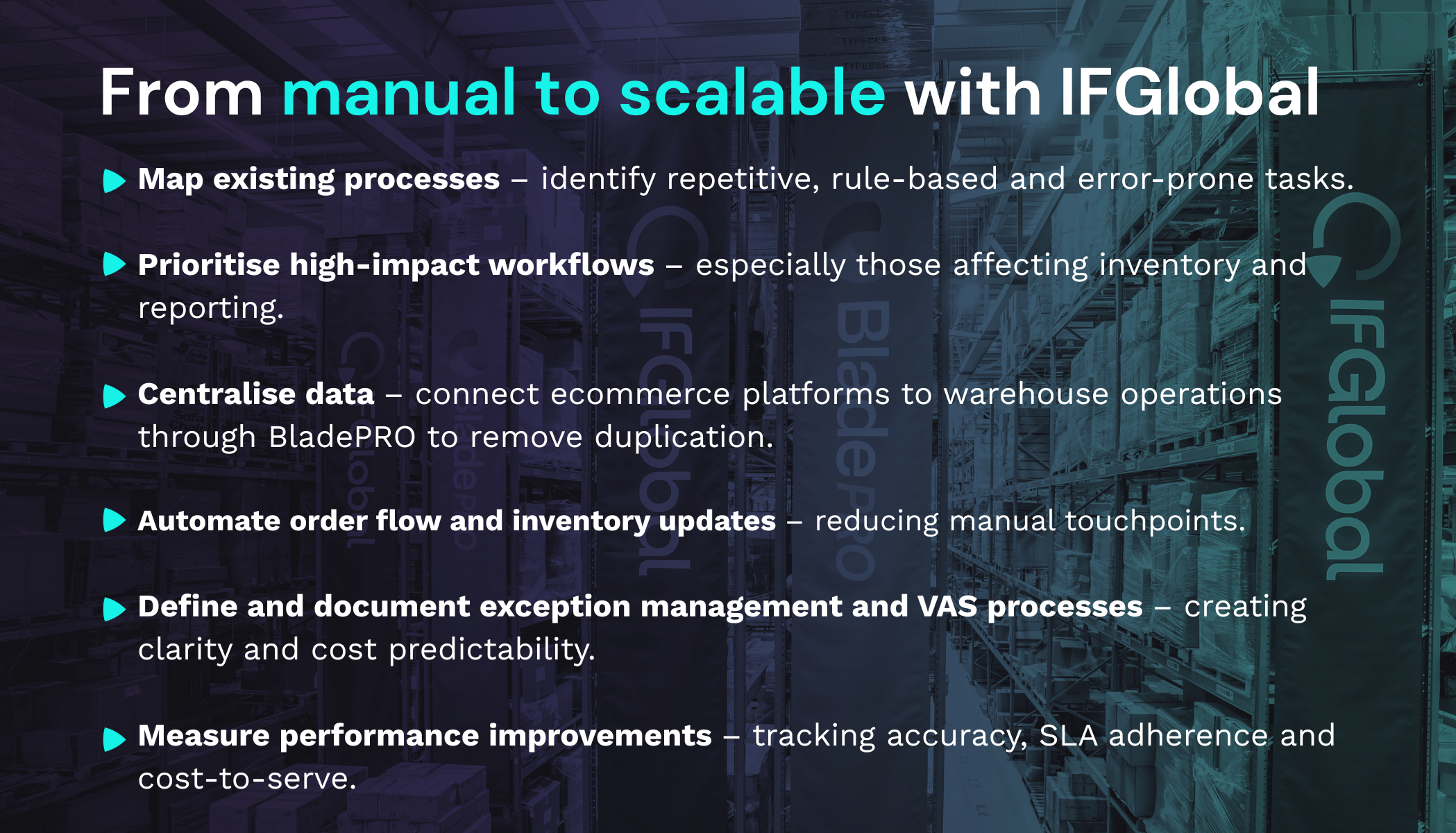
From manual to scalable: a structured approach
The goal is not to replace your teams. It’s to free them from repetitive, error-prone tasks so they can focus on strategic growth.
When you book a discovery call with us, we explore a practical transition plan, typically involving:
-
Mapping existing processes – identifying repetitive, rule-based and error-prone tasks.
-
Prioritising high-impact workflows – especially those affecting inventory and reporting.
-
Centralising data – connecting ecommerce platforms to warehouse operations through BladePRO to remove duplication.
-
Automating order flow and inventory updates – reducing manual touchpoints.
-
Defining and documenting exception management and VAS processes – creating clarity and cost predictability.
-
Measuring performance improvements – tracking accuracy, SLA adherence and cost-to-serve.
Centralisation is foundational. When systems communicate seamlessly, you’ll gain a new level of operational resilience and scalability.
-
Orders flow automatically from checkout to warehouse
-
Inventory updates in real time
-
Reporting is accessible instantly
-
Teams work from a single source of truth
Where we support growing brands
We believe fulfilment should be a growth enabler, not a hidden cost centre. Our fulfilment services are built around:
-
Clearly defined and documented workflows
-
Structured value-added services
-
Transparent labour scoping
-
Real-time inventory visibility
-
Scalable DTC and B2B capabilities
Alongside this, BladePRO centralises order management, inventory tracking and operational reporting to help brands move from reactive firefighting to proactive control.
Brands that invest early in structured fulfilment operations and connected systems position themselves to scale sustainably, without the silent tax of manual inefficiency.
If you’d like to explore how structured fulfilment with IFGlobal and BladePRO can support your next stage of growth, speak to one of our fulfilment experts today.