


GLOBAL BRANDS LOOKING FOR UNIFIED FULFILMENT



Choosing the right ecommerce fulfilment partner involves much more than comparing storage costs and pick-and-pack rates.
The best fulfilment providers combine operational excellence, scalable technology, strong carrier relationships and strategic support to improve customer experience, reduce costs over time, and create the operational foundations for sustainable business growth.
Key takeaways
-
Choose a fulfilment partner based on long-term value rather than the lowest price
-
Evaluate operational performance, technology, scalability and customer support, not just warehouse capacity
-
Consider where your business will be in three to five years, not just current order volumes
-
Look for partners with proven ecommerce expertise, transparent KPIs and recognised quality standards
-
Treat fulfilment as a strategic business function rather than simply a logistics service
Most ecommerce brands ask the wrong question
When businesses start comparing fulfilment providers, the first question is usually, "How much do you charge?"
It's understandable. Storage costs, pick-and-pack fees and courier rates are easy to compare because they’re clearly shown on every proposal.
The challenge is that they're rarely what determines whether a fulfilment partnership succeeds.
The businesses achieving the strongest customer retention and sustainable growth evaluate fulfilment differently. Rather than asking "Who's cheapest?", they ask:
-
Which provider can support our growth?
-
Will they improve our customer experience?
-
Can their technology scale with our business?
-
Do they proactively help us improve?
Fulfilment is no longer simply about moving products from A to B. It's become one of the biggest influences on customer satisfaction, operational efficiency and long-term profitability.
Why fulfilment has become a strategic business decision
Not so long ago, fulfilment was largely viewed as a warehouse function. As long as orders were picked accurately and dispatched on time, most businesses considered the job done.
Today, the landscape looks very different.
Customers don't separate the buying experience from the delivery experience: they see them as one continuous journey. A beautifully designed website, compelling marketing campaign or competitive product range counts for very little if the order arrives late or damaged.
Research from PwC consistently shows that delivery speed, convenience and reliability remain among the most important factors influencing where consumers choose to shop. As expectations continue to rise, fulfilment has become a critical part of the overall customer experience.
At the same time, global ecommerce sales are forecast to exceed $8 trillion by 2028. As more brands compete online, fulfilment is becoming one of the few areas where businesses can genuinely differentiate themselves.
Today, fulfilment influences far more than delivery. In other words, fulfilment has moved from the warehouse to the boardroom.
It affects:
- Customer satisfaction and loyalty
- Product reviews and brand reputation
- Inventory accuracy
- Marketing performance
- Marketplace seller ratings
- International expansion
- Operational efficiency
- Profitability
The hidden cost of choosing on price alone
Every ecommerce business has commercial targets.
Margins matter. Cash flow matters. Controlling operational costs will always be important. That's why it's understandable that many businesses begin comparing fulfilment providers by looking at storage rates, pick-and-pack charges and courier pricing.
The problem is that these costs only tell part of the story. The real cost of fulfilment is measured by what happens after an order is placed.
- Is it dispatched on time?
- Does it arrive when the customer expects?
- Is the order accurate?
- Can the customer return it easily if they need to?
Poor fulfilment creates costs that rarely appear on a pricing proposal. These include:
- Increased customer service enquiries
- Refunds and replacements caused by picking errors
- Lost sales due to inventory inaccuracies
- Poor customer reviews
- Higher return rates
- Time spent resolving avoidable operational issues
Individually, these issues might appear manageable. Collectively, they can have a significant impact on profitability and customer loyalty.
The cheapest fulfilment provider can become the most costly.
The six things every ecommerce business should evaluate
Choosing the right fulfilment partner requires a balanced assessment of operational capability, technology and long-term fit.
|
Evaluation area |
Why it matters |
|
Operational performance |
Reliable order accuracy, inventory management and dispatch protect customer experience and reduce unnecessary costs |
|
Technology |
Real-time inventory visibility, platform integrations and reporting improve decision-making and reduce manual administration |
|
Scalability |
Your provider should be able to support peak trading, new sales channels and international growth without disruption |
|
Carrier network |
Multiple carrier relationships provide greater flexibility, resilience and delivery choice for customers |
|
Customer support |
Dedicated account management and proactive communication help resolve issues quickly and identify opportunities for improvement |
|
Strategic partnership |
The best providers don't simply fulfil orders; they help improve operations and long-term performance |
A simple fulfilment evaluation framework
Before choosing a fulfilment partner, ask yourself:
-
Can they support our expected growth over the next three to five years?
-
Do they understand ecommerce, not just logistics?
-
Can they integrate with all our sales channels?
-
Do they provide real-time visibility of inventory and orders?
-
Can they demonstrate consistently high operational performance?
-
Will we have a dedicated account manager?
-
Do they review performance regularly and recommend improvements?
-
Can they support international expansion if our business evolves?
If you can't confidently answer "yes" to most of these questions, it's worth exploring alternative providers.
Why trust IFGlobal?
We’ve supported ecommerce brands with international fulfilment and logistics solutions for more than 20 years, helping businesses scale across multiple markets through operational expertise, technology, strategic support, and our global fulfilment centres.
Our operations are independently audited and supported by internationally recognised certifications that demonstrate our commitment to quality, security, compliance and continuous improvement:
-
ISO 9001 – Quality Management: Demonstrates robust, repeatable processes that help deliver consistent service, minimise errors and drive continual operational improvement.
-
ISO 14001 – Environmental Management: Reflects our commitment to sustainable operations and responsible environmental management.
-
ISO 27001 – Information Security: Confirms that our systems and processes meet internationally recognised standards for protecting customer and business data.
Alongside our ISO certifications, we also hold specialist accreditations that support brands operating in regulated sectors:
-
FDA registered facilities: Our FDA registration enables us to store and fulfil eligible products for the US market in line with regulatory requirements, helping health, wellness, food supplement and other regulated brands expand into the United States with confidence.
-
Soil Association certified: Our Soil Association certification enables us to handle and fulfil certified organic products while maintaining the integrity and traceability required throughout the fulfilment process, providing reassurance for organic and natural brands and the customers they serve.
These certifications demonstrate that our processes are independently assessed against recognised industry standards, giving ecommerce brands confidence that their fulfilment partner operates consistently and responsibly. They also help brands satisfy retailer and marketplace requirements, strengthen customer trust, reduce operational risk and support sustainable, long-term growth.
Combined with dedicated account management, continuous operational improvement and our proprietary BladePRO fulfilment platform, these standards enable us to deliver secure, reliable and scalable fulfilment solutions that grow alongside your business.
Download our complete guide
Choosing the right fulfilment partner is one of the most important operational decisions an ecommerce business will make.
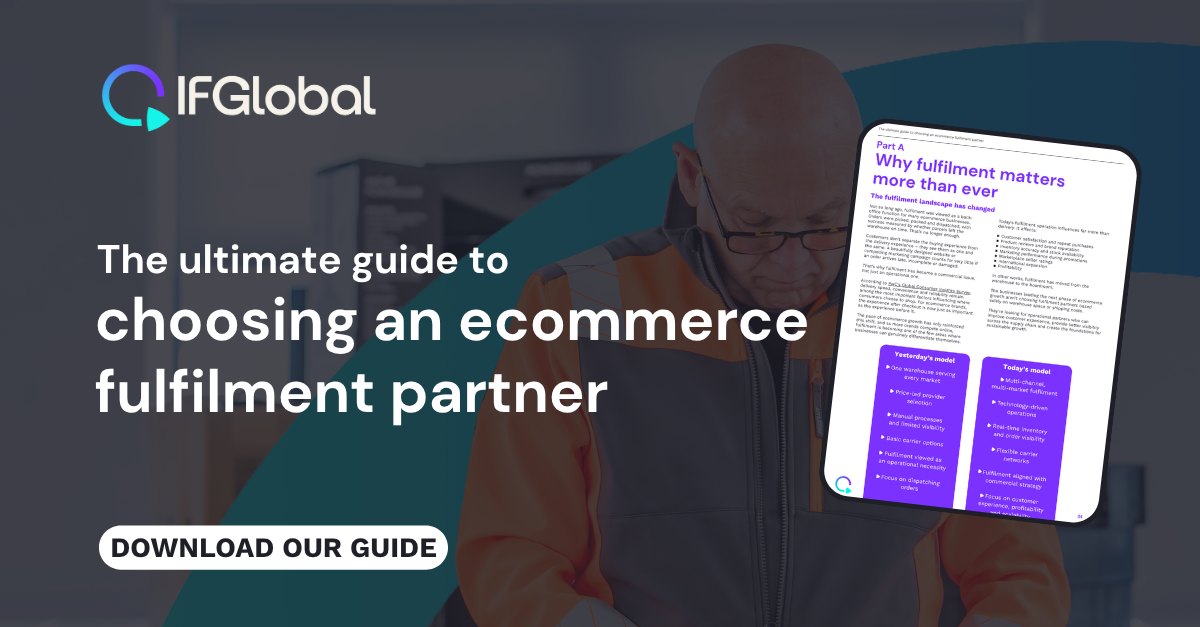
Our free guide to choosing an ecommerce fulfilment partner expands on the principles covered in this article and provides practical frameworks, checklists and insights to help you make an informed decision.
Whether you're reviewing your current provider or planning for future growth, it's designed to help you choose a fulfilment partner based on long-term value, not simply the lowest price.